Quantitative Fit Testing (QNFT) With a TSI PortaCount
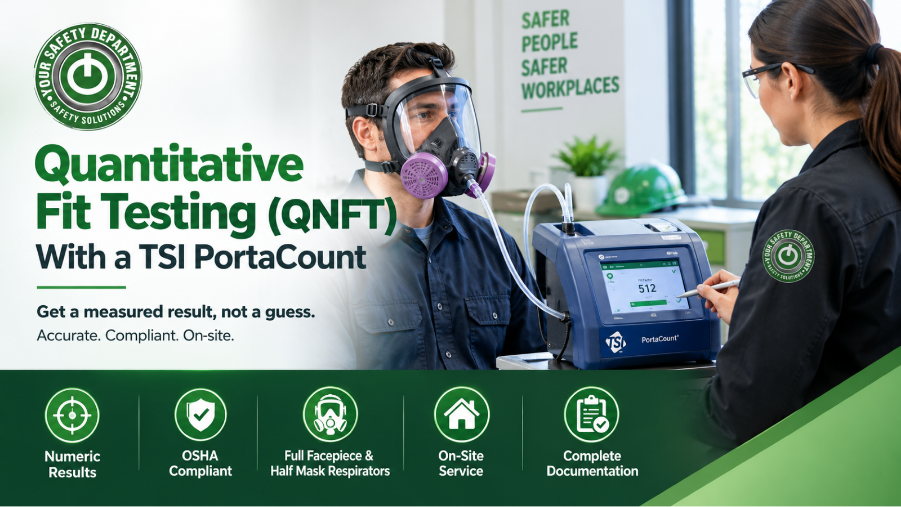
When a respirator needs a tight seal, you need a measured result, not a guess. Quantitative fit testing, or QNFT, gives you a clear result in numbers. Instead of relying on what a worker can taste or smell, a machine measures how well the respirator fits their face.
Your Safety Department performs QNFT with a TSI PortaCount, and we bring it to your site. Whether your crew wears full facepiece respirators or your site requires numeric results, we can help you meet the requirement.
What Quantitative Fit Testing Is
A quantitative respirator fit test uses a machine to measure how much air leaks around the respirator's face seal. Workers do not need to decide whether they can taste or smell anything because the machine measures the fit.
This makes QNFT a good choice when you need a clear, numeric result for each worker and respirator. The worker must wear the exact make, model, style, and size they use on the job, and the result applies only to that specific respirator.
QNFT is one of the methods OSHA accepts to meet fit testing requirements, and the standard explains how each method must be performed.
How QNFT Works
PortaCount fit testing uses tiny particles that are already present in the air around us. The TSI PortaCount is a condensation nuclei counter, so a condensation nuclei counter fit test simply means counting these particles.
The instrument counts particles in the room air and then counts them again inside the mask through a sampling adapter connected to the facepiece. If the mask fits well, far fewer particles enter it from the outside.
While the PortaCount measures the particles, the worker performs a series of exercises. These usually include breathing normally and deeply, turning the head from side to side and up and down, talking, and bending over.
These movements copy common activities at work, when the respirator seal might move. OSHA's Appendix A to 1910.134 lists the official exercises and testing steps, so check it for the exact requirements.
Before any of this happens, OSHA requires a medical evaluation before testing, and we start that online.
The Fit Factor
The fit factor is the number you receive after the test. It compares the number of particles outside the mask with the number inside it. A higher number means less leakage.
A worker passes when the overall fit factor meets the minimum required by OSHA's Appendix A. Under the standard PortaCount protocol, the minimum is 100 for half masks, including filtering facepieces, and 500 for full facepiece negative pressure respirators.
OSHA also accepts other quantitative testing protocols, so check the required passing score for the protocol being used.
When Quantitative Fit Testing Is Used
A full face respirator quantitative fit test is common for a simple reason. The standard allows qualitative pass-or-fail testing only for negative pressure respirators that need a fit factor of 100 or less. Full facepiece respirators often require a higher fit factor.
Some OSHA standards, such as the asbestos standard, also require quantitative testing for certain full facepiece respirators. Apart from these rules, many employers and site operators require numeric results as part of their safety programs.
Not sure which requirement applies to your crew?
Check the standard for your work, or ask us during your free initial consultation.
Quantitative vs Qualitative Fit Testing
Both methods are accepted by OSHA when they follow the required testing procedures. The main difference is how the respirator seal is checked and what result you receive.
|
Feature |
Qualitative |
Quantitative |
|
How it Works |
The worker reacts to a test agent, such as a taste or smell |
A machine counts particles inside and outside the mask |
|
Result Type |
Pass or fail |
A numeric fit factor |
|
Typical Use |
Commonly used for respirators that need a fit factor of 100 or less |
Often used for full facepiece respirators, or when a standard, operator, or site requires numeric results |
|
Equipment |
A test agent and a hood or enclosure |
TSI PortaCount and a sampling adapter |
Neither method is always better than the other. The right choice depends on the respirator and the requirements that apply.
What You Receive After the Test
After quantitative fit testing, the employer needs a record of the result. OSHA requires records to include the worker's name, type of fit test, exact make, model, style, and size of the respirator, test date, and test result.
The record must be kept until the next fit test. Ask us about the documents we provide when you schedule, so you know what to keep in your files.
Frequently Asked Questions
1. What is quantitative fit testing?
It is a way to measure respirator fit using a machine. The result is a number called a fit factor, so the outcome does not depend on what the worker can taste or smell.
2. How does a PortaCount measure respirator fit?
It counts tiny particles in the room air and inside the mask, then compares the two counts. Fewer particles inside the mask mean less leakage.
3. What is a fit factor?
It is the ratio of particles outside the mask to particles inside it. A higher fit factor means a better seal.
4. What fit factor is needed to pass?
Under the standard PortaCount protocol in OSHA's Appendix A, the minimum is 100 for half masks and 500 for full facepiece negative pressure respirators. Other accepted protocols may use different passing requirements.
5. Is quantitative fit testing better than qualitative fit testing?
Neither method is better in every situation. Quantitative testing gives a numeric result and is often used for full facepiece respirators. Qualitative testing gives a pass-or-fail result and is suitable for respirators with lower fit factor requirements.
6. When is quantitative fit testing used instead of qualitative?
It is often used when a respirator needs a fit factor above 100, as with many full facepiece respirators, or when a standard, employer, or site requires numeric results.
7. Can N95 respirators be quantitatively fit tested?
Yes. Filtering facepieces can be tested quantitatively, and the passing fit factor under the standard protocol is 100. If you are unsure which respirator your crew uses, read about respirator filter types.
8. How long does a quantitative fit test take?
The time depends on the number of workers and respirators involved, so we plan each visit based on your needs. Call us with your headcount, and we will help you schedule the visit.
9. What exercises are performed during the test?
Workers breathe normally and deeply, move their heads, talk, and bend over while the PortaCount measures particles. OSHA's Appendix A lists the official exercises.
10. What documentation do we receive after a QNFT?
OSHA requires employers to keep a record of each fit test until the next test. Ask us about the documents we provide when you schedule your appointment.
Ready to Schedule?
Need numbers, not guesses, for your crew?
Request quantitative fit testing, and we’ll bring the PortaCount to your site. It’s part of our onsite respirator fit testing service, so we can handle the medical questionnaire, training, and fit test in one visit. Tell us who needs testing and which respirators they use, and we’ll take care of the rest.